 Virtual Colossus
Cryptographic superiority in late-war Germany
The history of World War II cryptology is often dominated by the German Enigma machine and the Allied triumph of Ultra intelligence. However, the development of the Schlüsselgerät 41 (SG-41, or “cipher machine 41”) represents a crucial and largely successful attempt by German cryptographers to keep improving the security of their communications.
The cryptographic expert tasked with designing a replacement, Fritz Menzer, decided that Enigma was no longer secure and argued for replacing it completely with the SG-41. The aim was a new cipher device that was purely mechanical, durable, lightweight and practical for widespread use. The design rejected the rotor-and-reflector principle entirely, looking for a fundamentally different foundation for its security.
Fritz Menzer: from mechanic to master cryptologist
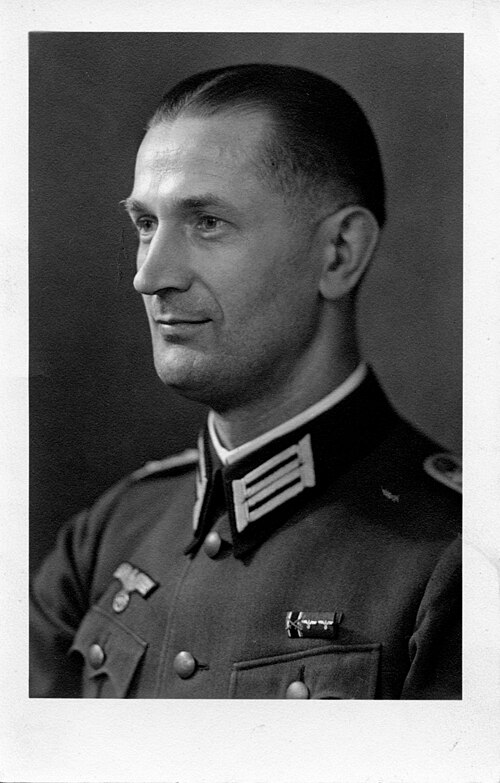
The SG-41 was the brainchild of Fritz Menzer (1908–2005), a unique figure in German cryptologic history. Menzer began his career by enlisting in the Reichswehr (German Army) as a mechanic at the age of 18. Despite having no formal training in advanced mathematics or electrical engineering, he developed an exceptional interest and expertise in cryptography, which eventually led to his appointment as Regierungsoberinspektor (Senior Government Inspector) at OKW/Chi in 1940.
Menzer’s preference for robust mechanical solutions and unconventional stepping mechanisms shows in his choice of design. The SG-41 was conceptually derived from the pin-and-lug cipher machines developed by the Swedish inventor Boris Hagelin, specifically the C-36 and C-38 series (similar to the American M-209 used during WWII). Adopting this purely mechanical principle, unlike the electrical rotor systems common at the time, was a deliberate change of direction: a practical engineer’s way of eliminating the mathematical weaknesses of the reflector-based Enigma.
Menzer’s life after the war was one of extreme obscurity, which helped delay recognition of the SG-41. After the war he worked as a teacher in Zschopau, was detained by Soviet forces, and eventually escaped to the West in 1949. Because of his lifelong silence, and official records ending in 1951, Menzer became known as a “phantom in German cryptology history”. Extensive recent research, particularly by the Deutsches Museum, based on newly declassified intelligence files, has finally brought his story and the details of his remarkable device to light. This high degree of post-war secrecy and compartmentalisation probably added to the machine’s reputation for cryptographic superiority, as its internal secrets were kept long after it went out of service.
Fritz Menzer: a secret life
The Deutsches Museum’s seven-part web documentary about Fritz Menzer.
Design
The SG-41 is quite different from Enigma: a pinnacle of mechanical cryptographic engineering, based on the Hagelin pin-and-lug principle.
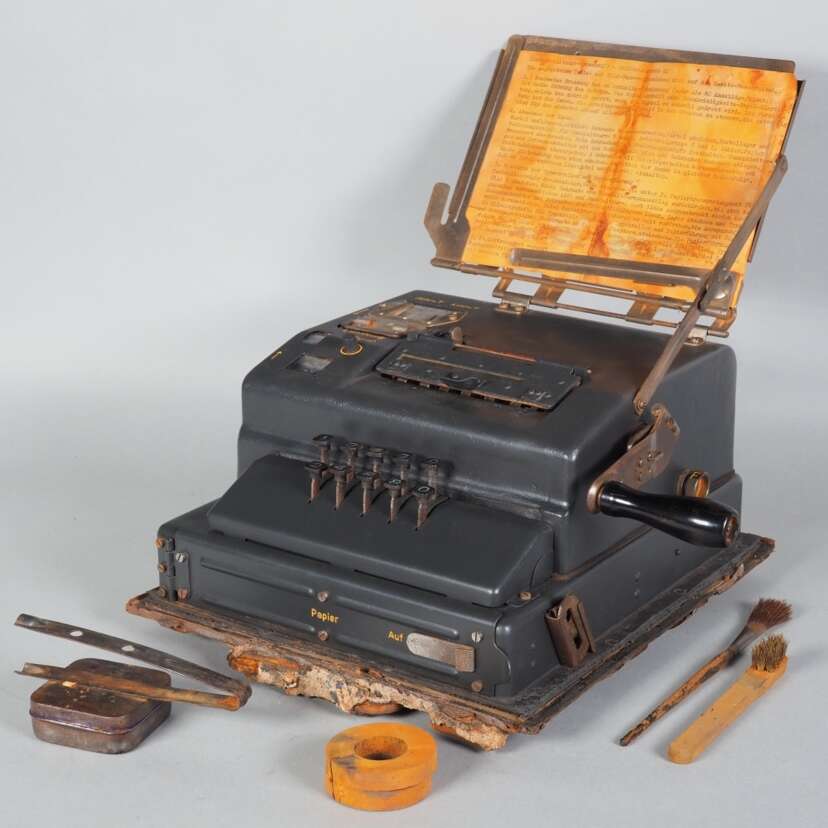
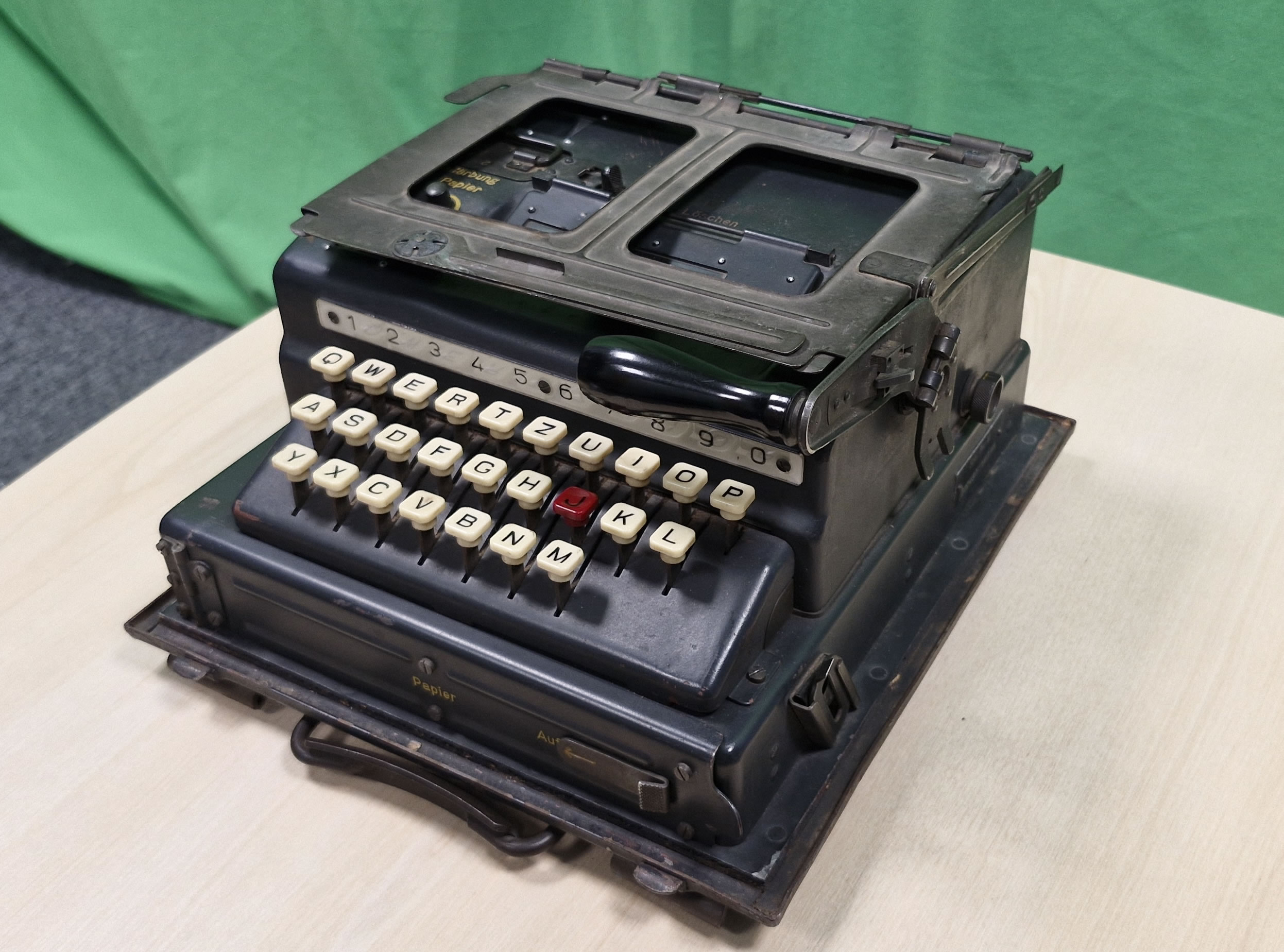
It is worked with a hand crank, which inspired its popular, if slightly derogatory, nickname: Hitlermühle (Hitler mill). It has a standard keyboard of 26 letters (A–Z), with the letter J used in place of the missing space.
Crucially, the SG-41 is a printing machine, so the operator doesn’t have to write down lit-up letters as with the Enigma lampboard. It uses two reels of paper tape, one for the plain text and one for the cipher text. The cipher text is formatted automatically with a space after every group of five letters, the usual way of laying out encrypted military traffic.
The printing mechanism, the keyboard and the mechanical precision needed for the SG-41’s complex internals probably drew on the industrial expertise of its manufacturer, Wanderer Werke AG, which was renowned for high-quality typewriters.
SG-41 models
Two models were made: the SG-41 itself, with a full 26-letter keyboard, and the cut-down, numbers-only SG-41Z, which had just ten keys, 0–9, for use with weather reports.
The pin-wheels and the key stream
The cryptographic heart of the SG-41 is its mechanical pseudo-random number generator (PRNG), driven by six pin-wheels. This generator decides the key value (K) used to encipher each character.
The rim of each pin-wheel is divided into a number of positions, each with a pin. These pins make up the machine’s internal configuration, or internal key. Each pin can be moved by hand to one of two states: inactive (0, the left position) or active (1, the right position). From left to right, the wheels have 25, 25, 23, 23, 24 and 24 pins.
Working out the key value K uses a mechanical adder known as the bar cage: a rotating drum with 25 bars that can slide sideways. The pins of wheels 1 to 5 are read at a particular position. If a pin is active, it adds a fixed mechanical step value (a “kick”) to the running total in the bar cage.
The values for the first five wheels are not simply in sequence, which is essential for the cipher’s strength: wheel 1 can give a kick of 1 step, wheel 2 a kick of 2, wheel 3 a kick of 4, wheel 4 a kick of 8 and wheel 5 a kick of 10.
Adding these steps together gives the total kick K. The values 1, 2, 4, 8 and 10 add a layer of non-linearity beyond a simple binary count. The first five can make any number from 0 to 25, and the sixth wheel has an inverting function, making the final value of K far harder to predict statistically.
Key management and key space
The security of the SG-41 rests on a sophisticated two-part key system: the highly random internal key and the changeable external key.
The internal key (daily key)
The internal key, often called the daily key, is the setting of all the pins. The six pin-wheels have 144 pins in all. As each pin can be active or inactive, the key space for the internal key is astronomical: 2144, or about 2.2 × 1043 possible settings. This far exceeds any key setting available on Enigma, giving immense resistance to brute-force attack.
Setting the internal key needs a precise manual procedure. The operator opens a hinged window over the pin-wheels and moves each pin by hand to its active or inactive position. The wheels lock automatically once the hand crank is turned. To start from a clean slate when changing the daily key, there is a procedure that resets every pin to inactive: the operator sets the F/L knob to L (Löschen, clear), holds the Löschen lever on top of the machine across to the left and turns the crank 25 full turns.
While this huge key space gives exceptional cryptographic security, setting 144 individual pins by hand made operator mistakes (misaligned or wrongly set pins) quite likely. Since procedural mistakes were historically the most exploited weaknesses of German cipher machines, this manual complexity was a potential operational risk, even though the machine’s mathematical design was impeccable.
The external key (message key)
The external key is the starting position of the six pin-wheels at the start of a message. It usually changed with each message or session, depending on the procedures in use. The starting position is set by the positions of the six wheels (the left four marked with letters, the right two with numbers), giving 190,440,000 possible starting positions. This means that even if the internal key were compromised, changing the external key often would limit how much traffic was sent with identical starting settings, making depth analysis harder.
Next: how the SG-41 works, part by part.