The Schlüsselgerät 41 (SG-41): Cryptographic Superiority in Late-War Nazi Germany
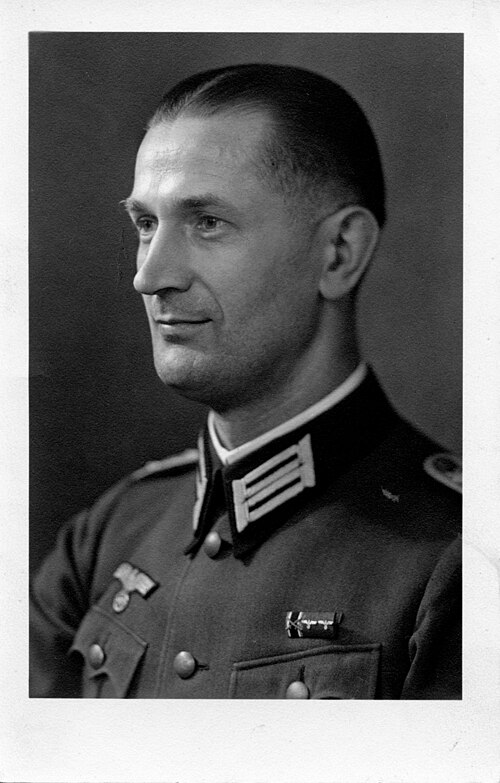
By Chrischy1980 - Familie Menzer, CC BY-SA 4.0, https://commons.wikimedia.org/w/index.php?curid=124786692
The history of World War II cryptology is often dominated by the German Enigma machine and the Allied triumph of Ultra intelligence. However, the development of the Schlüsselgerät 41 (SG-41, or "Cipher Machine 41") represents a crucial and largely successful attempt by German cryptographers to continue to improve their communication security.
The cryptographic expert tasked with designing a replacement, Fritz Menzer, determined that the Enigma was no longer secure and advocated for its complete replacement by the SG-41. The objective was to create a new cipher device that was purely mechanical, durable, lightweight, and practical for widespread use. The subsequent design rejected the rotor-and-reflector principle entirely, seeking a fundamentally different foundation for security.
Fritz Menzer: From Mechanic to Master Cryptologist
The SG-41 was the brainchild of Fritz Menzer (1908–2005), a unique figure in German cryptologic history. Menzer began his career by enlisting in the Reichswehr (German Army) as a mechanic at the age of 18. Despite lacking formal training in advanced mathematics or electrical engineering, he developed an exceptional interest and expertise in cryptography, eventually leading to his appointment as Regierungsoberinspektor (Senior Government Inspector) of OKW/Chi in 1940.
Menzer’s preference for robust mechanical solutions and non-traditional stepping mechanisms is evident in his choice of design basis. The SG-41 was conceptually derived from the pin-and-lug cipher machines developed by the Swedish inventor Boris Hagelin, specifically the C-36 and C-38 series (similar to the American M-209 machine used during WWII). The adoption of this purely mechanical principle, distinct from the electrical rotor systems prevalent at the time, reflected a deliberate technological pivot driven by a practical engineer’s approach to eliminating the mathematical vulnerabilities of the reflector-based Enigma.
Menzer’s life following the war was marked by extreme obscurity, contributing to the SG-41’s delayed recognition. After the conflict, he worked as a teacher in Zschopau, was detained by Soviet forces, and eventually escaped to the West in 1949. Due to his lifetime of silence and official records ceasing in 1951, Menzer became known as a "phantom in German cryptology history". Extensive recent research, particularly by the Deutsches Museum, based on newly declassified intelligence files, has finally brought his story and the details of his remarkable device to light. This high degree of post-war secrecy and compartmentalization likely contributed to the machine’s perceived cryptographic superiority, as its internal secrets were preserved long after its operational deployment ended.
Deutsches Museum's 7-Part Web Documentary "Fritz Menzer - a secret life"
Architectural Design
The SG-41 is architecturally distinct from the Enigma, representing a pinnacle of mechanical cryptographic engineering based on the Hagelin pin-and-lug principle.
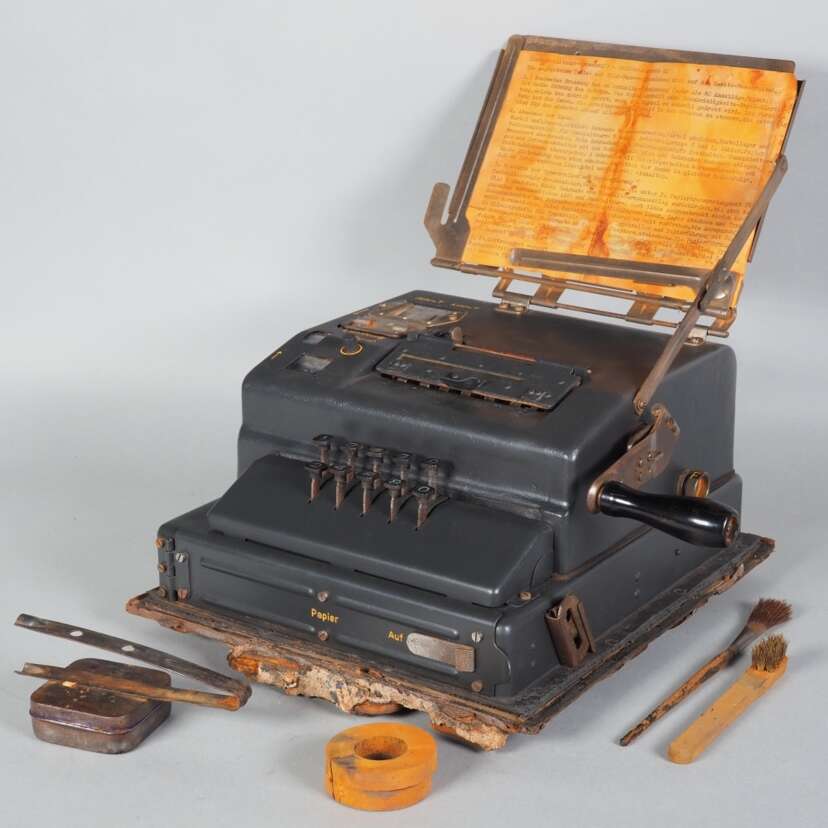
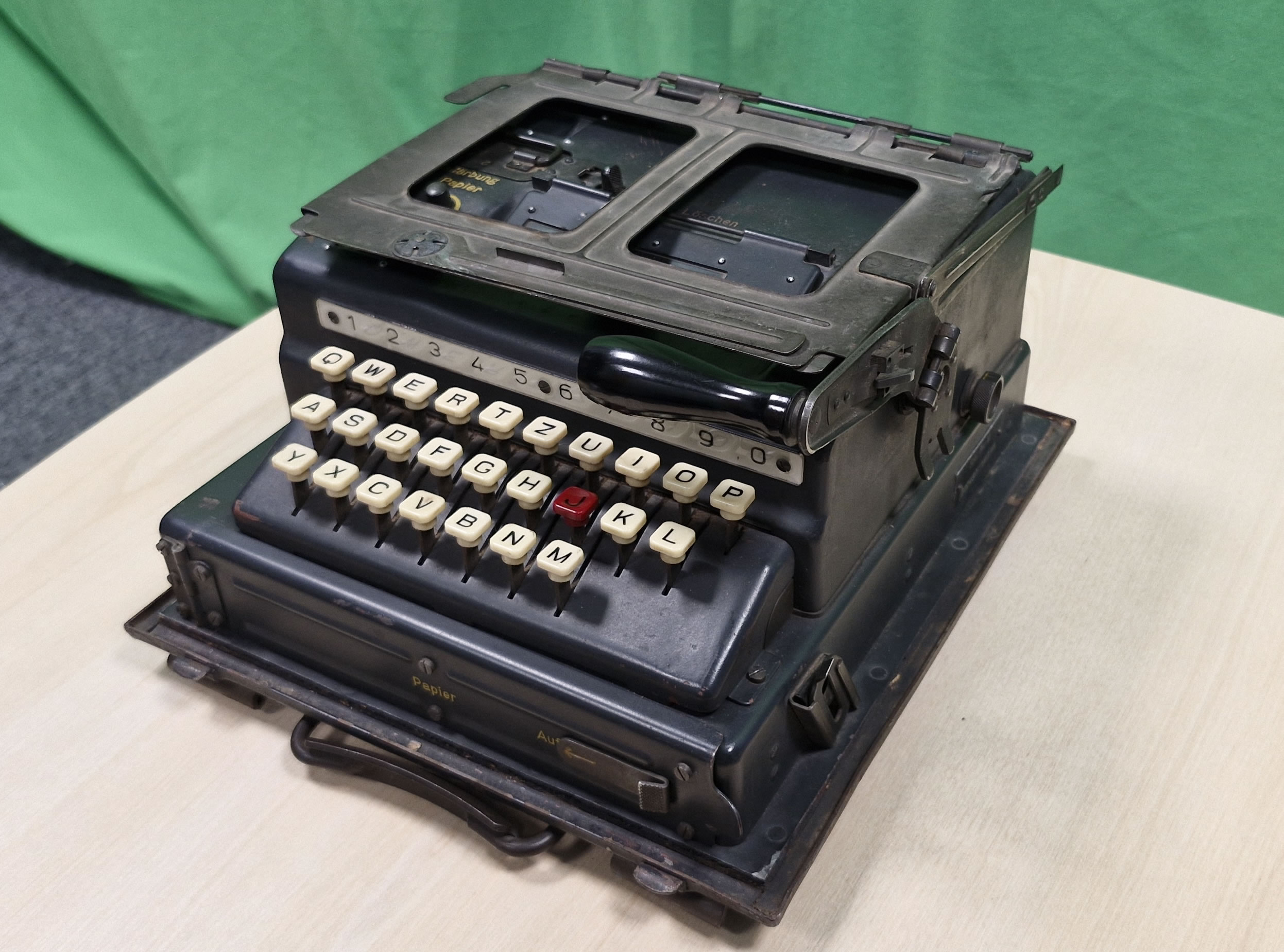
The SG-41 operates using a hand crank, which inspired its popular, though slightly derogatory, nickname: Hitlermühle (Hitler Mill). Physically, the machine uses a standard alphanumeric keyboard supporting 26 letters (A–Z), where the letter 'J' is utilized to represent the missing space character.
Crucially, the SG-41 functions as a printing device, eliminating the need for an operator to transcribe illuminated letters, as was the case with the Enigma lampboard. The machine uses two reels of paper tape: one for the plaintext input and one for the resulting ciphertext. The output is formatted automatically with a space inserted after every five-letter group in the ciphertext, a conventional method of formatting encrypted military traffic.
The printing output mechanism, keyboard interface, and mechanical precision required for the SG-41’s complex internal mechanisms likely leveraged the industrial expertise of its manufacturer, Wanderer Werke AG, which was renowned for producing high-quality typewriters.
SG-41 Models
There were two models created, the SG-41 itself which had a full 26 key alphabet keyboard and the cut-down numeric only SG-41Z which had just ten keys with the numbers 0-9 for use with weather reports.
Pin-Wheel Configuration and Key Stream Generation
The cryptographic core of the SG-41 is its mechanical Pseudo-Random Number Generator (PRNG), driven by six pin-wheels. This PRNG determines the key stream value (K) used to encipher each character.
Each of the six pin-wheels has a circumference divided into a certain number of segments, with a corresponding pin located at each segment. These pins define the machine’s internal configuration, or "Internal Key." A pin can be manually shifted to one of two states: Inactive ('0', or left position) or Active ('1', or right position). The wheels from left to right have a different number of pins; 25, 25, 23, 23, 24 and 24 in total.
The calculation of the key stream value K involves a mechanical adder known as the 'bar cage,' a rotating drum containing 25 horizontally movable bars. The pin states of Wheels 1 through 5 are sensed at a specific position. If a pin is sensed as Active, it imparts a fixed, predefined mechanical step value (or 'kick') to the running total in the bar cage.
The fixed values assigned to the first five wheels are not purely sequential, which is essential for cryptographic robustness: Wheel 1 can give a kick of 1 step, Wheel 2 a kick of 2 steps, Wheel 3 gives 4 steps, Wheel 4 gives 8 steps and Wheel 5 a total of 10 steps.
The summation of these steps determines the total additive kick K. The contribution values (1, 2, 4, 8, 10) introduce a layer of non-linearity beyond a simple binary interpretation. The first five values allow for the generation of any number from 0 to 25 with the sixth wheel which has an inversion function, significantly complicating the statistical predictability of the final K value.
Key Management and Keyspace
The security of the SG-41 relies on a sophisticated, two-tiered key management system: the highly randomized Internal Key and the variable External Key.
The Internal Key (Daily Key)
The Internal Key, often referred to as the Daily Key, is the programmed setting of all the pins. The six pin-wheels collectively contain 144 pins. Since each pin can be set to either active or inactive, the total key space for the Internal Key is astronomical, calculating to 2144, or approximately 2.2x1043 possible configurations. This key space dramatically exceeds the complexity of any key configuration available to the Enigma, providing immense resistance against brute-force attacks.
Setting the Internal Key requires a precise manual procedure. The operator must open a hinged window covering the pin-wheels and physically adjust the pins to their required active or inactive states. The device is designed to lock the wheels automatically once the hand crank is operated. To ensure a clean slate for daily key changes, a dedicated procedure exists to reset all pins to the inactive state: the operator sets the F/L knob to 'L' (Löschen or clear), holds down the 'Löschen' key, and makes 25 full revolutions of the crank.
While this extensive key space provides exceptional cryptographic security, the sheer complexity of manually setting 144 individual pins introduced a high probability of operator error (misalignment or incorrect pin settings). Given that procedural faults were historically the most exploited vulnerabilities in German cryptographic devices, this level of manual complexity represented a potential operational security risk, even though the machine’s mathematical design was impeccable.
The External Key (Message Key)
The External Key is the specific alignment of the six pin-wheels at the start of a message. This setting typically varied with each message or communication session, depending on the established procedural protocols. The initial alignment is determined by the positions of the six wheels (the leftmost four marked with letters, the rightmost two with numbers). The total number of unique starting positions available through the External Key is calculated to be 190,440,000 possible combinations. This mechanism ensures that even if the Internal Key remained compromised, frequent changes in the External Key would limit the amount of traffic sent using identical initial settings, thus increasing resistance to depth analysis.